

XPANCEO and INTRA-KER Develop Intracorneal Implant to Restore Vision in Patients with Corneal Blindness
XPANCEO
September 5, 2025
XPANCEO
September 5, 2025
XPANCEO, a deep tech company building the next generation of computing via smart contact lens, has partnered with INTRA-KER, an Italian medtech startup, to develop an intracorneal implant designed to restore vision in patients with damaged or opaque corneas. Using a projecting system similar to the one in the smart contact lens, the device delivers visual information directly to the retina, bypassing the need for a transparent cornea. INTRA-KER has patented this innovative approach, marking a significant step forward in the field of vision restoration.
Human vision requires a precise optical system. Light first enters the eye through the cornea, which provides most of its focusing power, then passes through the lens and is projected onto the retina, a neural layer at the back of the eye that converts visual information into neural signals for the brain. When the cornea becomes cloudy or scarred, incoming light is blocked or distorted, severely impairing vision even if the retina remains healthy.
For patients with advanced corneal scarring or opacities, corneal transplantation is currently the standard treatment. However, more than 12 million people are on waiting lists for donor tissue, while only about 185,000 corneal transplants are performed worldwide each year. Moreover, at least 8,000 of these transplants are expected to fail annually.
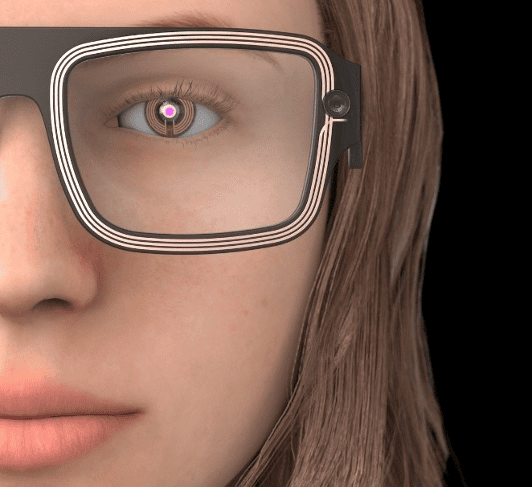
XPANCEO and INTRA-KER are addressing this critical gap by developing an intracorneal implant that embeds a microdisplay, similar to the one used in XPANCEO’s smart contact lens, in place of the diseased cornea. Until recently, implanting electronic components in this part of the eye was not considered feasible. INTRA-KER’s patented intracorneal design makes this possible. Visual data is captured by external smart glasses equipped with an embedded camera and transmitted wirelessly to the implant, using the same communication and power delivery protocols that XPANCEO has demonstrated in its smart contact lens prototypes.
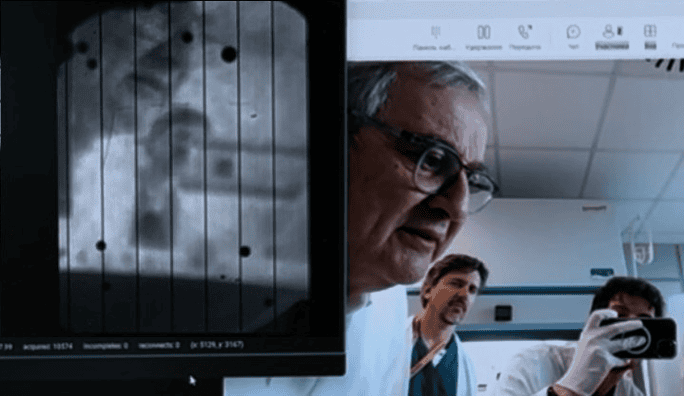
The initial proof of concept combined a 450×450 pixel display with XPANCEO’s micro-optical projection system, resulting in a 5.6mm package. For clinical use, the entire system must be miniaturized. XPANCEO has already demonstrated even thinner optical systems and is now optimizing the display module to match. Early testing included immersion in liquid to verify correct operation in conditions similar to those inside the eye, followed by placement in a donor human eye to assess optical performance, which was conducted in cooperation with the Venice Eye Bank. The implant successfully delivered relatively sharp visual content to the retina.
“For clinical use, we aim to miniaturize the entire system,”says Dr. Valentyn Volkov, founder of XPANCEO.“With over 12 million people awaiting corneal transplants, we see this as the beginning of a new era, where advanced optics and computation can bridge longstanding gaps in vision care.”
![valentyn[20617754].jpg](https://assets.xpanceo.com/valentyn_20617754_f3a08569f7.jpg)
Over the next two years, XPANCEO plans to finalize a surgically implantable version for clinical trials. The procedure is expected to resemble standard corneal surgery in complexity and duration, as all electronic components are fully encapsulated and biocompatible.
“Until now, implanting electronics in the anterior segment of the eye has not met with success,” said Prof. Massimo Busin of INTRA-KER. “With only 185,000 traditional corneal transplants performed each year, we see a critical need for solutions that don’t rely on donor tissue. This system is made possible by our IP protected technology, which enables precise and safe implantation of sealed electronic components using a procedure no more complex than standard corneal surgery.”

With scaled production, the cost of the implant could eventually approach that of a flagship smartphone. The global addressable market is estimated at $50–200 million annually, with the potential to redefine the future of accessible vision restoration.